


Keeta Network: Mainnet Is Almost Here
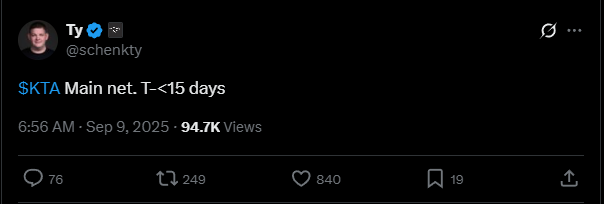
The countdown is on, and the crypto space is watching closely. On September 9, Keeta Network founder Ty Schenk confirmed that mainnet is less than 15 days away. That announcement, which quickly spread through social channels, set a definitive timeline for one of the most anticipated launches of 2025.
Keeta is not just another Layer-1 entering the arena. Over the past year, it has combined a compelling vision, technical performance that exceeds industry expectations, and the credibility of having Eric Schmidt as a lead backer. Together, those factors have made it a project worth paying attention to as it moves from development into real-world deployment.
Leadership and Vision
Ty Schenk has been building in crypto long before Keeta. In 2018, he co-founded BrainBlocks, a fee-free payment system built on Nano that pushed the idea of instant, low-cost transfers. He later worked as a software engineer at Turo, gaining experience in scaling consumer-facing platforms, before starting Keeta in Santa Monica in 2022.
Schenk’s mission for Keeta has always been clear: make international payments as seamless as Venmo while meeting the regulatory and institutional requirements that are often missing in blockchain infrastructure. His technical background, combined with a history of building payment systems, has shaped Keeta’s design into something that merges speed with compliance from the ground up.
Eric Schmidt’s Backing
One of the strongest endorsements for Keeta has come from Eric Schmidt, the former CEO of Google. Schmidt led Keeta’s $17 million seed round in 2023, valuing the company at $75 million, and has since become one of its most prominent advocates. His statement that Keeta’s technology is “orders of magnitude more scalable and efficient than existing solutions” underscored how seriously he views its potential.
Schmidt’s career background adds weight to his involvement. He oversaw Google’s transformation into a global powerhouse during his decade at the helm and has remained active as an investor and advisor across the technology landscape. While he does not hold an executive role at Keeta, his support has opened doors to fintech collaborations, institutional conversations, and credibility that few early-stage blockchain projects ever receive.
Technical Milestones
Keeta’s architecture has been engineered for performance and compliance from the beginning. The project uses a hybrid design that combines delegated Proof-of-Stake with a directed acyclic graph (DAG) ledger. This structure allows parallel transaction processing while maintaining strong security and near-instant finality.
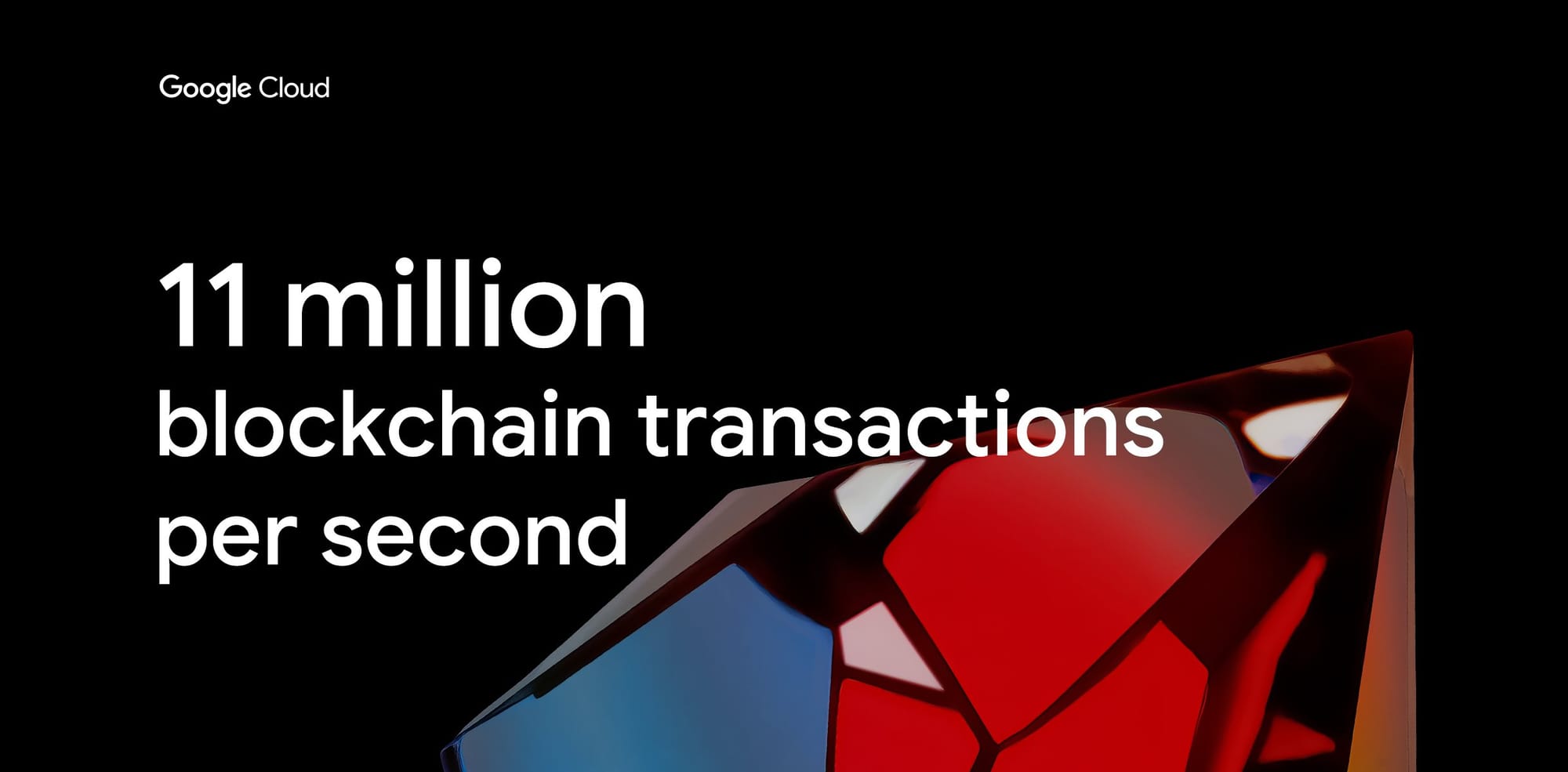
The standout moment so far came in June 2025, when Keeta conducted a public stress test in collaboration with Google Cloud engineers. The network peaked at 11.2 million transactions per second while processing more than 26 billion transactions across 30 million simulated accounts. The infrastructure backbone was Google Cloud Spanner, a globally distributed SQL database that allowed Keeta to scale horizontally without downtime.
The results were significant enough that Google Cloud featured Keeta on its official blog in August 2025, marking the first time a blockchain project has received that spotlight. For the crypto community, it was validation that Keeta’s claims were not just theoretical but grounded in measurable outcomes.
The Token Journey
Keeta’s native token, KTA, has reflected the project’s milestones and market sentiment throughout 2025. It launched quietly in March, surged when Eric Schmidt’s involvement became public, and spiked again in May as anticipation for mainnet built. By June, KTA hit an all-time high of $1.69 on the heels of the stress test results.
The summer correction was sharp, with prices dipping below $0.70, as skepticism and delays fueled profit-taking. Yet August brought a strong rebound. Google Cloud’s public endorsement and new exchange listings helped KTA recover to around $1.40 before stabilizing in the $1.10 to $1.20 range in September. With mainnet now just days away and KTA recently added to Coinbase’s listing roadmap, the token is positioned for a new phase defined less by speculation and more by real network utility.
Why Keeta Is in Our Spotlight

With mainnet less than two weeks away, Keeta is in the spotlight for clear reasons:
- Proven leadership: Ty Schenk has years of experience building crypto payment systems and is executing a vision to simplify global payments.
- Credible backing: Eric Schmidt’s involvement has brought both investment and legitimacy, giving Keeta access to opportunities few projects achieve.
- Technical results: Verified throughput of over 11 million TPS, with Google Cloud engineers validating the performance.
- Institutional readiness: Built-in compliance, identity verification, and tokenization features designed for real-world finance.
- Token momentum: KTA has weathered volatility and is entering its most important stage with mainnet utility on the horizon and a recent addition to Coinbase’s listing roadmap.
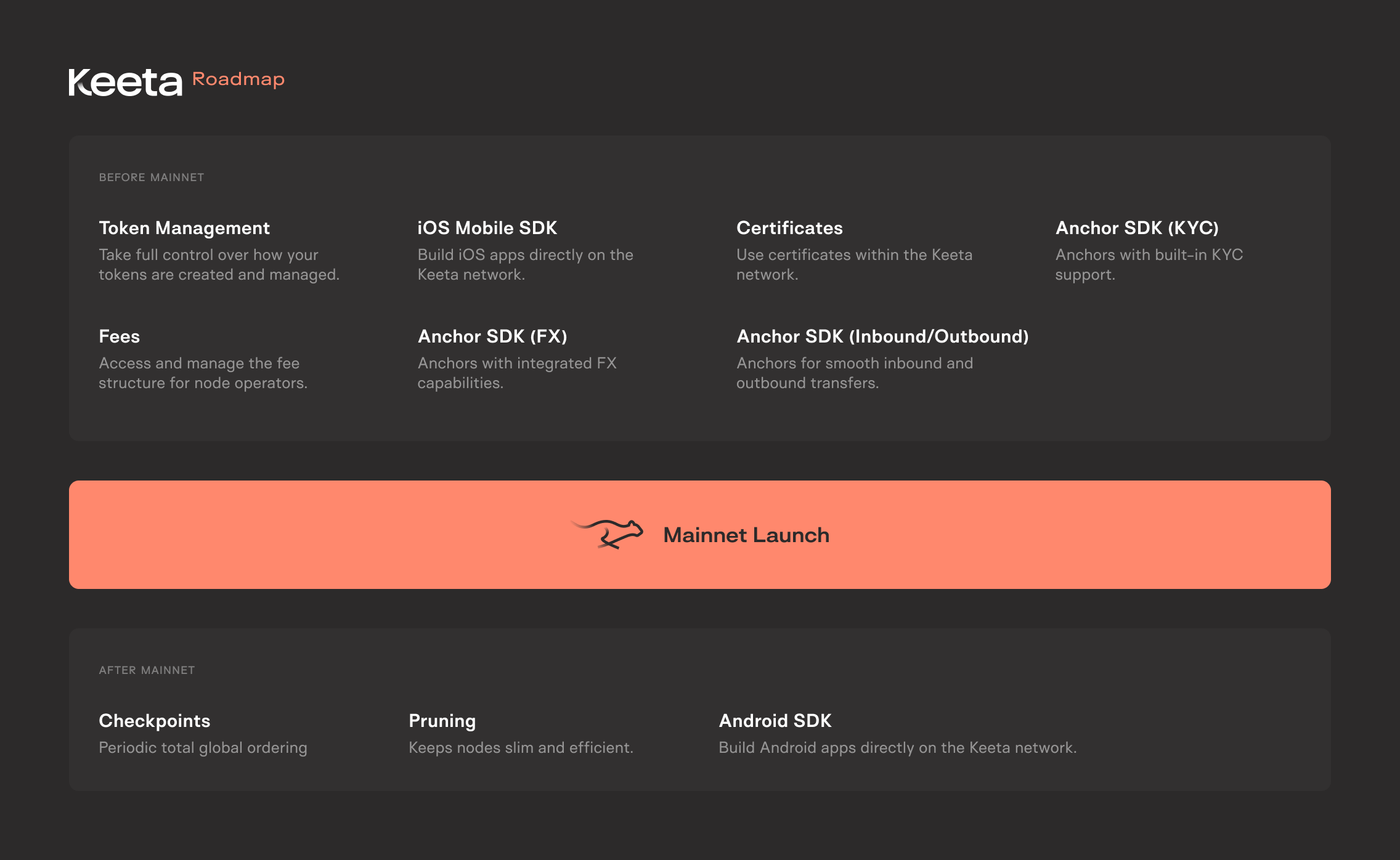
Keeta’s mainnet launch is more than a technical milestone. It is the point where the project proves whether years of design, testing, and high-profile support can translate into adoption. With performance validated, institutional interest growing, and leadership aligned on a clear mission, Keeta is positioned as one of the defining blockchain launches of 2025.